

Nov 8, 2026 · 3 min read
Eisenkot Government Bid: Herzog Picks Him Over Netanyahu
Eisenkot government bid begins as Herzog picks him over Netanyahu with 67 endorsements; he has 28 days to reach 61...
Iran missile limit of 2,000 kilometres has been lifted, the Revolutionary Guard said, as Washington reported fresh action near the Strait of Hormuz.
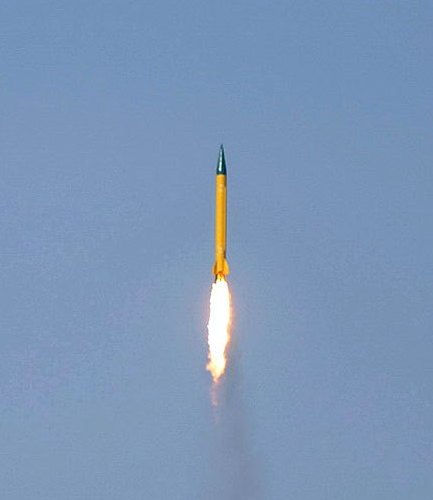
Iran missile limit rules that had capped the country’s ballistic rockets at 2,000 kilometres, or about 1,200 miles, have been lifted, the Islamic Revolutionary Guard Corps said, according to the Associated Press and Iran’s ISNA news agency.
IRGC spokesperson Brigadier General Hossein Mohebbi made the remarks on the sidelines of a press conference for IRGC Aerospace Week in Tehran. “The restriction has been lifted for us,” he said, adding that Iran intended to show the capability in practice rather than only talk about it. The quotes were carried by ISNA and reported by The Times of India, which cited the same briefing.
For years, Iranian officials had described the 2,000-kilometre ceiling as a self-imposed political choice, not a treaty obligation. AP noted that Iran is not known to have fielded missiles beyond that range, while US officials have said technology from Iran’s space programme could be adapted for longer-range systems. The Guard’s new line suggests that informal ceiling is no longer policy.
A 2,000-kilometre range already covers much of the Middle East, including Israel and US bases in the region. A longer reach would, in theory, put more distant targets at risk. Mohebbi did not name a new maximum range, identify a specific missile, or say when a longer-range test would take place. He said only that the restriction had been removed and that the Guard’s duty was to demonstrate capability on the battlefield.
He also framed Iran’s approach as asymmetric warfare. According to ISNA, he said Iranian forces could strike an adversary “at a location it would never anticipate” and bring it to a standstill. Those comments are claims by a military spokesman, not independently verified results. No new missile launch was documented in the reports that accompanied the announcement.
The timing matters because the region is already under strain. Shipping through the Strait of Hormuz has faced repeated alerts this year, including earlier accounts of tanker fires in the strait and reported strikes around Qeshm Island. Diplomacy has also stalled, as covered in our earlier report that Iran-US talks produced no breakthrough.
The Times of India, citing AP, said the briefing came a day after US President Donald Trump told reporters that American forces had carried out what he called a minor strike on a newly built Iranian anti-aircraft installation. Trump said the system was destroyed within minutes. He was speaking after arriving in West Palm Beach, Florida, on Friday evening.
Iranian state media reported hearing two explosions in the Suza area of Qeshm Island, which sits in the Strait of Hormuz, a passage that carries a large share of the world’s seaborne oil. Asked about those blasts, Mohebbi said Iranian forces had conducted firing exercises and that most of the explosions were air-defence fire. He also said an American aircraft was hit during the firing, without offering evidence, the aircraft type, or the outcome. Trump did not give further detail about Friday’s US target beyond the air-defence claim.
US officials have previously said many of Iran’s air-defence systems were destroyed or badly weakened during Israeli bombardments in June 2025 and in the early phase of the current conflict. They have also said Tehran would try to rebuild those defences. The latest exchange, if confirmed in fuller military accounts, would fit that pattern of limited strikes and local air-defence fire rather than a single, decisive battle.
Several points should be read with care. The Guard’s statement changes a declared policy; it does not by itself prove that a missile with a range beyond 2,000 kilometres has been built, tested or deployed. Mohebbi’s claim that an American aircraft was hit has not been corroborated by US officials in the reports cited here. Trump’s description of a “minor” strike also lacks an independent battle-damage assessment in those same accounts.
For readers in Thailand, the story matters because any wider clash around Hormuz can move global oil prices and, with them, local fuel and shipping costs. The announcement also lands as other political crises compete for attention, including Israel’s post-election effort after the Eisenkot government bid began.
Until a test, a deployment notice or satellite imagery shows a longer-range system, the factual core is narrower than the rhetoric: Iran’s Revolutionary Guard has said the old range cap is gone, and both Tehran and Washington are describing fresh military activity around one of the world’s most sensitive waterways.
The announcement was reported by the Associated Press, with additional quotes from ISNA as carried by The Times of India.
Photo: A displayed ballistic missile, used here to illustrate the Iran missile limit debate (Hossein Velayati via Wikimedia Commons, CC BY 4.0).
Eisenkot government bid begins as Herzog picks him over Netanyahu with 67 endorsements; he has 28 days to reach 61...
New Zealand election ends with no clear winner: National wins 42 seats, Labour 36, and the Opportunity Party could...

Pope Leo tour of South America starts in Uruguay on a 12-day trip also visiting Argentina and Peru, with a call for...

Qeshm Island strikes confirmed by Trump as minor hits on Iranian air defences, while Qatar says mediation with Iran...
Zelensky warns Russia is preparing fresh attacks on Ukraine’s energy grid and Dnipro bridges, urging faster Patriot...

French protests cost of living actions drew ~600,000 by ministry count and a CGT claim of 1.57 million as Lecornu s...